
Wildlife Encounter — Edition 002
Wild Killer Whale Encounter in Monterey Bay — Field Story & Photography Techniques
By Wildlife Photographer Lee Andelson
This wild killer whale encounter was photographed off Monterey Bay during building storm conditions while documenting Bigg’s killer whale behavior in real ocean weather. In the Wild Encounter series, wildlife photographer Lee Andelson shares real field stories, camera techniques, and wildlife behavior insights from encounters in the wild.
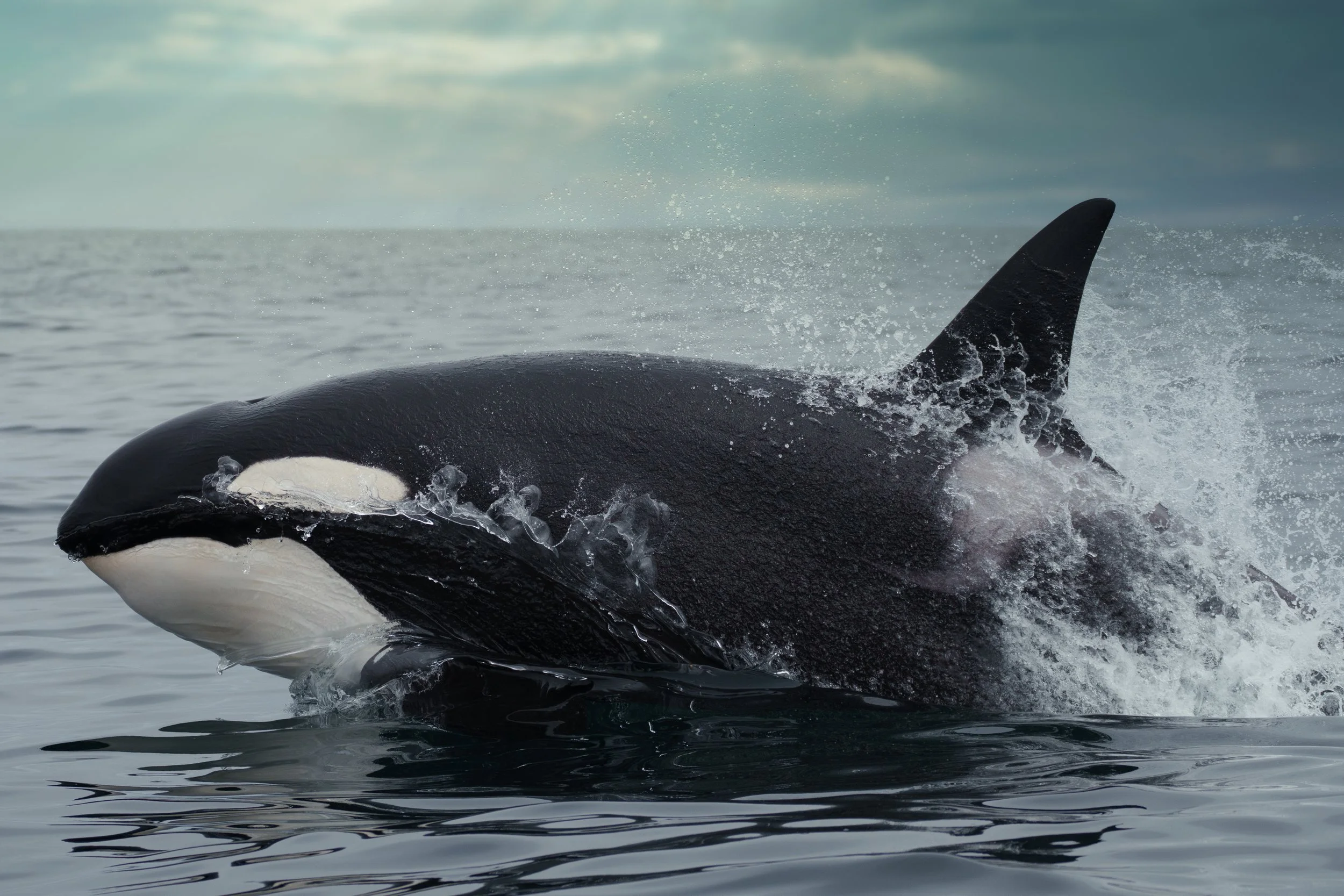
Encounter Field and Camera Data:
Location: Monterey Bay, California
Species: Bigg’s Killer Whale (Transient Orca)
Behavior: Travel / Power Surface
Conditions: Pre-storm swell, shifting wind, low sunset light
Camera Setup:
Camera Body: Sony A1
Lens: Telephoto wildlife lens (400–600mm range typical)
Shutter: ~1/3200 sec
Aperture: ~f/4.5
ISO: Auto (variable based on light drop)
Killer Whale Encounter in Monterey Bay — The Field Story
Some moments in the wild don’t leave you. They move in. They change how you measure time, silence, and your place in the natural world. This image came from one of those moments — the kind that quietly rewires something inside you long after the ocean goes flat again.
This encounter happened off Monterey on the edge of a major storm system. All day we fought building swell, confused wind, stacked weather, and visibility windows that opened and slammed shut just as fast. It was the kind of day where you question whether persistence is smart or just stubborn. But if you spend enough years on the water, you learn something important — wild moments rarely arrive when it’s easy. They arrive when most people have already turned around.
Late in the day, right before sunset, the sky did that thing. If you know, you know. The light softened, but somehow intensified at the same time. The ocean surface flattened just enough. The air changed. It felt like the entire ocean was holding its breath.
And then they showed up.
Bigg’s killer whales — CA122As, CA122B, and the CA212s (T342s). They moved with purpose. They moved like they owned the storm itself.
I’ve spent years photographing marine wildlife across the Pacific Northwest, Alaska, California, and beyond, working in real ocean conditions where moments like this are earned, not staged. Encounters like this are never random. They are built on field time, pattern recognition, and respect for how wild animals actually move through their world.
How This Killer Whale Image Was Captured — Field Technique
Moments like this are never just “right place, right time.” They are prepared place, earned time, and controlled chaos.
On days like this, boat handling matters just as much as camera skill. The goal is to stay predictable to the animals, minimize your profile in swell lines, and use wave direction to stabilize your shooting platform. Whenever possible, I want the sun behind my shoulder, but you never force positioning. You let encounters develop naturally.
In building weather, killer whales often travel more directly and surface with less warning. That means you are not chasing breaches. You are reading movement lines, body tension, and direction of travel to anticipate where energy will surface next.
This whale pushed water hard. That means momentum — not casual movement. When I see that kind of body tension, I’m already shooting. Not reacting. Predicting.
Camera Settings for Fast-Moving Marine Wildlife Photography
Storm light forces a very specific mindset: speed over perfection.
Shutter speed comes first because you do not get do-overs with explosive surfacing. In conditions like this, I typically work between 1/2500 and 1/4000 second. Aperture usually lives between f/4 and f/5.6 to balance subject isolation with enough depth forgiveness if the shooting plane shifts. ISO floats. Modern sensors exist for a reason. Noise can be cleaned. Motion blur can’t.
Autofocus tracking is critical. Shooting through spray means trusting your system and committing to continuous tracking instead of trying to reacquire focus each burst.
Reading Killer Whale Behavior for Photography Timing
What you’re seeing in this image isn’t just a surfacing. It’s timing inside timing. It’s reading breath interval patterns, watching dorsal tracking angle against swell direction, anticipating power surfacing versus travel surfacing, tracking eye patch angle for storytelling composition, and shooting through spray without focus hunting.
Marine wildlife photography is less about reacting and more about building a prediction model in your head based on behavior, water movement, and environmental pressure.
Why Wild Encounters Matter Beyond Photography
There’s a moment sometimes where you stop being a photographer and you’re just… small. Not in a bad way. In a correct way. You’re standing next to power that doesn’t know you exist and doesn’t need to. That’s where respect comes from. That’s where conservation starts. That’s where stories that matter actually begin.
Wild Encounter — Captured & Shared isn’t about showing cool wildlife photos. It’s about documenting the relationship between humans and wild places. Every person who forms a real connection with the wild becomes someone more likely to fight to protect it.
For Wildlife Photographers Following This Series
If there’s one takeaway from this image, it’s this:
You don’t chase moments like this.
You prepare for years so when the wild decides to show you something — you’re ready.
Explore Real Wildlife Encounters
If experiences like this matter to you, you can explore upcoming small-group wildlife photography tours through Wake Up To Adventure, where encounters are documented ethically and in real field conditions.